


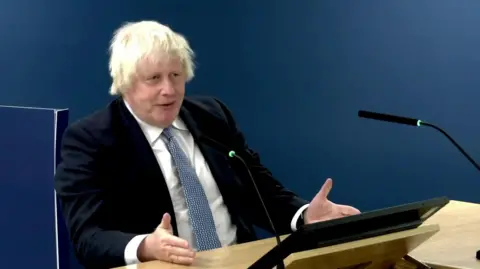
 Government Inquiry Hearing
Students paid a "huge cost" to protect the public during the coronavirus crisis, the former prime minister has stated to the inquiry examining the effect on youth.
The former leader repeated an expression of remorse delivered earlier for things the administration mishandled, but stated he was pleased of what teachers and schools accomplished to manage with the "incredibly challenging" situation.
He countered on previous assertions that there had been insufficient strategy in place for closing learning institutions in early 2020, stating he had presumed a "significant level of consideration and care" was at that point being put into those decisions.
But he explained he had furthermore desired learning facilities could stay open, labeling it a "nightmare idea" and "private fear" to shut them.
Prior Statements
The hearing was advised a strategy was merely developed on 17 March 2020 - the day prior to an declaration that educational institutions were closing down.
Johnson told the proceedings on Tuesday that he recognized the concerns around the lack of strategy, but added that making changes to learning environments would have required a "far higher state of awareness about the coronavirus and what was likely to happen".
"The quick rate at which the disease was spreading" complicated matters to plan regarding, he continued, stating the key emphasis was on trying to avert an "appalling health emergency".
Conflicts and Exam Results Crisis
The investigation has additionally been informed earlier about several tensions between administration officials, for example over the judgment to close down learning centers once more in 2021.
On the hearing day, the former prime minister told the inquiry he had wanted to see "large-scale screening" in educational institutions as a way of maintaining them operational.
But that was "not going to be a runner" because of the recent alpha type which emerged at the identical period and accelerated the dissemination of the illness, he noted.
One of the biggest issues of the crisis for all authorities came in the exam scores fiasco of summer 2020.
The schools administration had been forced to reverse on its use of an system to assign grades, which was intended to stop elevated marks but which instead resulted in forty percent of expected outcomes downgraded.
The widespread protest resulted in a reversal which meant learners were finally given the marks they had been forecast by their teachers, after GCSE and A-level tests were scrapped beforehand in the period.
Reflections and Future Pandemic Planning
Mentioning the assessments situation, hearing advisor suggested to Johnson that "the entire situation was a disaster".
"Assuming you are asking the coronavirus a tragedy? Yes. Was the absence of learning a disaster? Certainly. Did the cancellation of exams a tragedy? Certainly. Was the letdown, anger, dissatisfaction of a significant portion of children - the further disappointment - a catastrophe? Certainly," Johnson stated.
"But it must be viewed in the framework of us trying to cope with a significantly greater disaster," he added, referencing the absence of learning and tests.
"On the whole", he commented the learning department had done a quite "heroic effort" of attempting to deal with the outbreak.
Later in the day's testimony, Johnson stated the restrictions and physical distancing guidelines "probably went overboard", and that young people could have been spared from them.
While "with luck a similar situation not happens once more", he said in any subsequent pandemic the closure of schools "truly should be a step of ultimate solution".
The present stage of the Covid inquiry, looking at the impact of the pandemic on young people and students, is due to end later this week.

