


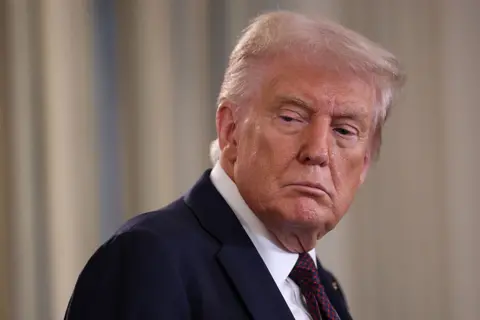
America's highest court starts its latest docket on Monday with a docket currently loaded with potentially major legal matters that might define the scope of the President's governmental control – along with the prospect of more matters approaching.
During the past several months since the administration was reelected to the executive branch, he has pushed the boundaries of executive power, solely implementing recent measures, cutting public funds and personnel, and trying to place previously self-governing institutions further subject to his oversight.
Constitutional Conflicts Over National Guard Mobilization
A recent brewing legal battle arises from the administration's moves to take control of local military forces and send them in cities where he claims there is civil disturbance and rampant crime – against the opposition of regional authorities.
Within the state of Oregon, a judicial officer has delivered rulings preventing Trump's use of military personnel to the city. An higher court is scheduled to reconsider the action in the coming days.
"We live in a nation of judicial rules, rather than martial law," Judge the court official, whom the administration nominated to the judiciary in his previous administration, stated in her latest ruling.
"Government lawyers have made a range of claims that, should they prevail, threaten blurring the line between non-military and defense national control – harming this republic."
Shadow Docket Could Determine Troop Power
When the appellate court has its say, the justices could intervene via its referred to as "expedited process", handing down a decision that might limit the President's authority to employ the military on American territory – or grant him a free hand, for now interim.
This type of processes have become a more routine occurrence recently, as a majority of the court members, in response to urgent requests from the White House, has largely authorized the administration's measures to proceed while legal challenges play out.
"A tug of war between the High Court and the trial courts is poised to become a major influence in the next docket," an expert, a instructor at the prestigious institution, remarked at a briefing last month.
Objections Regarding Emergency Review
Justices' reliance on the emergency process has been criticised by progressive academics and politicians as an unacceptable use of the court's authority. Its orders have often been concise, offering limited justifications and providing trial court judges with minimal guidance.
"Every citizen ought to be alarmed by the High Court's increasing dependence on its emergency docket to resolve contentious and notable matters without the usual openness – without comprehensive analysis, courtroom debates, or rationale," Politician the New Jersey senator of his constituency said previously.
"That further drives the justices' discussions and decisions away from public oversight and shields it from responsibility."
Full Reviews Ahead
During the upcoming session, nevertheless, the justices is scheduled to tackle matters of presidential power – and other prominent disputes – directly, holding courtroom discussions and issuing full judgments on their basis.
"It's not going to have the option to brief rulings that don't explain the justification," said Maya Sen, a professor at the Harvard Kennedy School who studies the Supreme Court and US politics. "If they're planning to grant greater authority to the administration they're will need to explain why."
Significant Disputes within the Agenda
The court is currently scheduled to review the question of national statutes that bar the president from firing members of institutions established by lawmakers to be independent from White House oversight infringe on executive authority.
Judicial panel will additionally hear arguments in an accelerated proceeding of the administration's bid to fire Lisa Cook from her position as a member on the influential central bank – a matter that might dramatically enhance the president's authority over US financial matters.
The nation's – plus international economic system – is further a key focus as court members will have a opportunity to rule whether a number of of the administration's unilaterally imposed tariffs on foreign imports have adequate statutory basis or must be invalidated.
Court members could also consider the administration's efforts to independently cut public funds and terminate junior government employees, in addition to his aggressive border and deportation policies.
Although the court has yet to consented to consider Trump's effort to terminate automatic citizenship for those delivered on {US soil|American territory|domestic grounds
